Where Women Can Reach Gynecologic Care
A composite 2026 ranking of the ten countries where a woman can most easily reach contraception, antenatal care, a midwife or gynecologist, and emergency obstetric surgery, and the ten where that chain breaks first.

Where Women Can Reach Gynecologic Care — and Where They Cannot
A composite 2026 ranking of the ten countries where a woman can most easily reach contraception, antenatal care, a midwife or gynecologist, and emergency obstetric surgery — and the ten where that chain breaks first.
There is no official world league table for “how easy it is for a woman to see a gynecologist.” Search engines and comparison sites invent one anyway, usually by averaging female life expectancy with a handful of WHO scores and calling the result a ranking. That is not what this article does.
Access is a chain. A woman needs a service that exists within a reachable distance, a provider she is allowed to see, money or insurance that will pay for it, a legal regime that does not criminalize the care she needs, and a health system that can still function when the hemorrhage starts at two in the morning. Break any link and the clinic on the map becomes a rumor.
What follows is a composite snapshot for 2026. It is built from the World Health Organization’s universal health coverage service coverage index for 2023, the United Nations Maternal Mortality Estimation Inter-Agency Group figures for 2023 (published 2025), skilled-birth-attendance and contraceptive-use series compiled by UNFPA and UNICEF, and the legal and workforce facts that those indices cannot see. The ten “easiest” countries are not a beauty contest of GDP. They are the places where that chain usually holds. The ten “hardest” are the places where it usually does not — including one, Afghanistan, where the barrier is no longer only poverty but a ban on training the next generation of female clinicians.
How this ranking was built — and what it is not
Four questions sat under every country on the list.
Does a woman survive pregnancy at rates that imply functioning obstetric care? The MMEIG 2023 maternal mortality ratio is the blunt instrument here. Norway’s point estimate is 1 death per 100,000 live births. Nigeria’s is 993. A 15-year-old girl in Australia or New Zealand faces a lifetime maternal-death risk of about 1 in 21,000. In sub-Saharan Africa the same risk is about 1 in 55.
Does the health system cover essential services without forcing her into catastrophic spending? The WHO UHC service coverage index for 2023 runs from 92 in Canada to 26 in Chad. High-income countries cluster at 85–90. Low-income countries sit near 47. The index is not a gynecology score, but its reproductive, maternal, newborn and child-health sub-index is the closest global proxy that exists.
Can she reach a skilled attendant and modern contraception? UNICEF reports that 86 percent of births worldwide had a skilled attendant in 2023, but only 74 percent in sub-Saharan Africa. In Somalia the figure is about 32 percent. Modern contraceptive prevalence among all women of reproductive age is 63–70 percent in the Netherlands and Norway and 7–8 percent in Chad and Somalia.
Do law, conflict, geography and money still let her walk through the door? This is the unindexed layer. Taliban mahram rules and the December 2024 ban on women’s medical education in Afghanistan do not appear as a line in the UHC index. Neither does a two-day walk to the nearest operating theatre in rural Chad, nor a $400 out-of-pocket cesarean in Port-au-Prince.
Countries that score well on coverage but badly on outcomes, or the reverse, were read in both directions. The United States, with a UHC index of 88 and a maternal mortality ratio around 17 — several times the Nordic and Japanese figures — is not on the “easiest” list. China and South Korea score well on some outcome composites but were set aside because this article is about reaching care, not only about surviving it. Cuba’s coverage numbers are high; its medicine shortages in 2025–2026 are not. Those caveats belong in the text, not in a footnote no one reads.
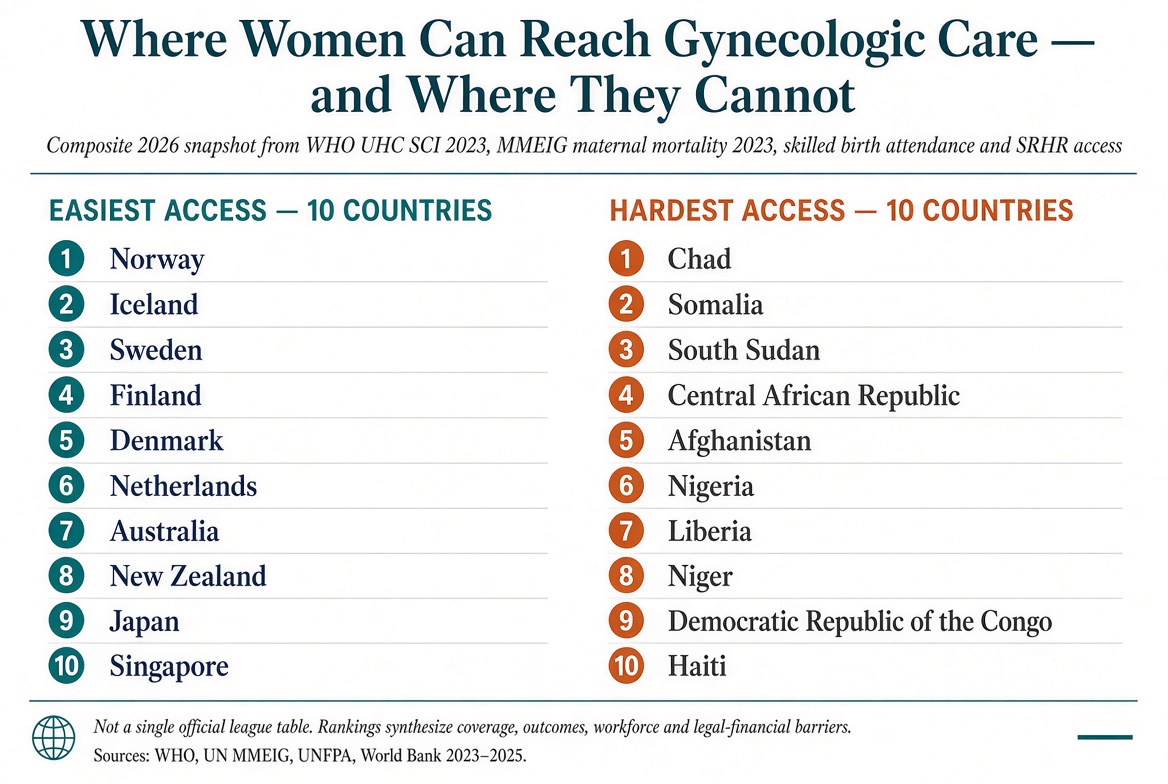
Figure 1. Composite 2026 snapshot. Sources: WHO UHC SCI 2023; UN MMEIG maternal mortality 2023; UNFPA/UNICEF skilled attendance and contraceptive series; legal and workforce reporting 2024–2026.
The ten countries where access is easiest
The easy list is not a surprise. It is a description of what tax-financed primary care, midwife-led maternity systems, short distances, and a legal right to contraception look like when they run at the same time. Five of the ten are Nordic. Two are antipodean. Two are high-income East Asian city-states or islands with dense hospital networks. One — the Netherlands — is the European midwife system that other countries keep trying to import without importing the rest of the architecture.
# | Country | MMR 2023 | UHC SCI | What the numbers miss |
|---|---|---|---|---|
1 | Norway | 1 | 89 | Public financing; midwife-GP-hospital ladder; almost no OOP for essential SRH |
2 | Iceland | ~3 | 90 | Small island, short distances, one national system |
3 | Sweden | ~4 | 85 | Barnmorska midwife model; youth clinics; abortion in the public system |
4 | Finland | ~8 | 86 | Neuvola maternity clinics from first trimester through infancy |
5 | Denmark | ~4 | 85 | Leads Georgetown WPS Index 2025/26; strong legal SRHR frame |
6 | Netherlands | 4 | 85 | Primary midwife for low-risk birth; home birth still a designed option |
7 | Australia | 2 | 89 | Medicare + PBS; remote Aboriginal gap remains the exception |
8 | New Zealand | 7 | 89 | Lead Maternity Carer model; midwife as default coordinator |
9 | Japan | 3 | 86 | Universal insurance; dense hospital grid; contraception less frictionless |
10 | Singapore | ~6 | 88 | City-state distances; mixed public-private; high out-of-pocket share |
Table 1. Easiest-access list. MMR is the MMEIG 2023 point estimate per 100,000 live births. UHC SCI is the WHO 2023 service coverage index (0–100).
What the easy countries share — and what they do not
Money is the first shared fact, and it is not the last. All ten are high-income. All ten run some version of universal coverage, whether tax-based (Nordics, Australia, New Zealand) or social insurance (Japan, Netherlands, Singapore). A first antenatal visit, a copper IUD, a cervical screen, and an emergency cesarean do not, in ordinary cases, require a family to sell an animal or take a loan. That is the financial-protection half of UHC, and it is why these countries stay on the list even when waiting times irritate the middle class.
The second shared fact is a midwife or generalist who sits in front of the obstetrician. Norway, Sweden, Finland, Denmark, the Netherlands and New Zealand built maternity systems in which a midwife is the default clinician for uncomplicated pregnancy. The gynecologist is downstream, not the first door. That design does two things at once: it multiplies the number of skilled hands a woman can reach, and it keeps the specialist free for the cases that need an operating theatre. Countries that try to solve access by training only obstetricians discover that obstetricians cluster in cities and then complain of burnout.
The third is law that does not make the clinician a criminal. Contraception is legal, stocked, and usually subsidized. Abortion regimes vary — Japan remains more conservative on oral emergency contraception than its mortality numbers would predict; Singapore is more regulated than Sweden — but none of the ten treats a first-trimester termination as a police matter for the woman or a prison risk for the doctor in routine practice. That legal weather is part of access. A service that exists on paper and is dangerous to provide is not a service.
What they do not share is culture, religion, or a single model of the family. Japan’s contraceptive mix still leans on condoms and a late, incomplete embrace of the pill. Singapore’s MediSave logic asks households to pay more at the point of care than Oslo does. Australia’s easy access stops, sharply, in some remote Aboriginal communities, where distance and workforce vacancies reproduce a low-income country’s problem inside a high-income state’s border. The ranking describes the median woman in the median postcode. It does not describe every woman.
Socioeconomics on the easy side of the line
These countries did not stumble into low maternal death. They spent decades paying for it. Female secondary and tertiary enrolment is high. Mean age at first birth sits in the late twenties or early thirties. Fertility is below replacement, which reduces the lifetime number of times a woman is exposed to obstetric risk — a cold demographic fact that flattens mortality even before the hospital is excellent. Paid parental leave and subsidized childcare are not gynecology, but they are why a woman can keep an antenatal appointment without losing a day’s cash wage.
There is a political economy underneath the clinics. Small, high-trust states can staff a neuvola or a community midwifery practice because the tax base is broad and the distances are short. Iceland’s entire population would fit inside a single Nigerian state capital. That is an advantage, not a virtue. It is also why copying “the Nordic model” into a federation of 200 million people is a slogan until someone funds the midwives and builds the roads.
The ten countries where access is hardest
The hard list is not simply “Africa.” It is a specific combination of very high maternal death, very low service coverage, thin surgical and midwifery density, and — in several cases — armed conflict or a legal order that keeps women from the remaining staff. Nigeria is on the list because it accounts for more than a quarter of the world’s maternal deaths, not because its UHC index is the lowest. Afghanistan is on the list because policy is now dismantling the female clinical workforce that the country still has. Haiti is on the list because a health system can collapse in a middle-income neighbourhood of the Caribbean as thoroughly as in the Sahel.
# | Country | MMR 2023 | UHC SCI | Primary break in the chain |
|---|---|---|---|---|
1 | Chad | 748 | 26 | Lowest UHC index on earth; SBA ~47%; modern CPR ~8% |
2 | Somalia | 563 | 30 | SBA ~32%, lowest recorded; conflict; modern CPR ~1–8% |
3 | South Sudan | 692 | 41 | Protracted conflict; SBA ~40%; flooded and roadless counties |
4 | Central African Republic | 692 | 39 | State fragility; surgical deserts outside Bangui |
5 | Afghanistan | 521 | 42 | Mahram rules; Dec 2024 ban on women’s medical education |
6 | Nigeria | 993 | 47 | ~75,000 maternal deaths in 2023 — 29% of the world total |
7 | Liberia | 628 | 49 | Post-conflict workforce hole; high lifetime obstetric risk |
8 | Niger | 350 | 39 | Highest fertility on earth; modern CPR in the low teens; distance |
9 | DR Congo | 427 | 41 | ~19,000 maternal deaths; war in the east; fistula burden |
10 | Haiti | 328 | 44 | Gang siege of Port-au-Prince; hospitals closed or looted |
Table 2. Hardest-access list. MMR and UHC SCI as in Table 1. Skilled-birth-attendance and contraceptive figures from UNFPA State of World Population 2025 and UNICEF delivery-care series.
Chad, Somalia, South Sudan, CAR: when the state cannot keep a theatre open
Chad sits at the bottom of the WHO coverage index for a reason. Forty-seven percent of births have a skilled attendant. Modern contraceptive prevalence among all women aged 15–49 is about 8 percent; among married women it is 9 percent. Unmet need sits near one woman in five. The maternal mortality ratio of 748 per 100,000 live births means that obstetric hemorrhage, eclampsia and sepsis are still population events, not rare case reports. Distances in the Sahel are not a metaphor. A woman in a prefecture without a functioning blood bank or a surgical team is not “underserved.” She is outside the system.
Somalia’s skilled-attendance rate — about 32 percent in the most recent compiled figures — is among the lowest recorded anywhere. Modern contraceptive use hovers between 1 and 8 percent depending on the series and the denominator. The state does not hold the whole territory. Midwives and surgical teams work where security and donor logistics allow, which is not where most women deliver. Female genital mutilation remains near-universal in some communities, which is not itself a coverage statistic and is still a gynecologic fact: scarred tissue, obstructed labour, fistula.
South Sudan and the Central African Republic add active conflict to the same thin infrastructure. WHO’s 2025 maternal-mortality report noted that 37 countries classified as being in conflict or institutional fragility accounted for 61 percent of global maternal deaths while representing only 25 percent of live births. The MMR in conflict-affected settings was estimated at 504 per 100,000, against 99 in settings that were neither conflict nor fragile. That is the difference between a health system and a corridor of aid.
Afghanistan: access withdrawn by decree
Afghanistan is the one country on the hard list whose 2026 problem is not only that the system is poor. It is that the authorities are closing the pipeline of women who can staff it.
The MMEIG 2023 ratio is already 521 per 100,000. Skilled attendance, on paper, is higher than in Somalia — around 68 percent in the UNFPA 2025 annex — because a generation of donor-built midwifery training produced female clinicians after 2001. The Taliban’s movement rules then put a mahram requirement between many rural women and those clinicians. UN Women has reported that four in five rural women it consulted could not reach a facility without a male guardian. In some provinces, women may not be treated by a male doctor. That would be manageable if female doctors, nurses and midwives were being trained at scale. In December 2024 the de facto authorities banned women from medical, nursing and midwifery education and from the exit examinations that feed the workforce.
UNICEF has warned that Afghanistan could lose thousands of female health workers by 2030 if the education and employment bans hold. A 2026 modelling study in The Lancet Global Health projected that care-seeking for maternal and reproductive services could fall to between one-third and one-half of current levels as the female workforce ages out and is not replaced. This is access in reverse: a country that had begun to staff women’s wards with women is legislating those wards empty. No UHC index captures a ban on training. The ranking has to.
Nigeria and the Democratic Republic of the Congo: scale without coverage
Nigeria’s ratio of 993 is the highest point estimate in the 2023 MMEIG series. The absolute number matters more for the world’s ledger. About 75,000 Nigerian women died of maternal causes in 2023 — 28.7 percent of every maternal death on earth. India and the DRC contributed about 19,000 each. Four countries — Nigeria, India, the DRC, Pakistan — held almost half the global total.
Nigeria is not Chad. Lagos teaching hospitals perform the full range of gynecologic oncology and reproductive surgery. The failure is distribution. Northern states combine high fertility, low female schooling, long distances, and a private market that prices the poor out of a cesarean. The UHC index of 47 is a national average that conceals a country in which a woman in a state capital and a woman in a rural local government area do not live in the same health system. Access rankings that treat Nigeria as a single data point are describing a federation with the mortality profile of a humanitarian emergency sitting next to the private clinics of a middle-income city.
The DRC adds war in the east and a fistula caseload that is itself a map of untreated obstructed labour. Coverage of 41 on the UHC index and an MMR of 427 describe a system that can be excellent in Kinshasa and absent a day’s walk from Goma.
Niger, Liberia, Haiti: fertility, aftermath, and collapse
Niger’s MMR of 350 is lower than Chad’s and still belongs on this list because fertility and distance multiply risk. A woman who begins childbearing in adolescence and has six or seven births faces a lifetime obstetric exposure that no coverage index fully prices. Modern contraceptive use remains in the low teens. The state is large, the roads fail in the rainy season, and the midwife density cannot match the birth cohort.
Liberia’s 628 ratio is the long shadow of civil war and Ebola: training pipelines broken, surgical posts unfilled, a generation of clinicians scattered. Haiti’s 328 ratio would not, on a quiet year, put it next to the Sahel. 2024–2026 has not been a quiet year. Armed groups have besieged Port-au-Prince, looted depots, and forced hospitals to close or run on generators and donated oxytocin. A Caribbean state with a teaching-hospital tradition can drop onto a hardest-access list in three years if the streets between the woman and the theatre are no longer passable.
What “access” hides when the index looks fine
Three countries that did not make either ten are the ones readers will argue about.
The United States has an UHC index of 88 and spends more per woman than any Nordic state. Its maternal mortality ratio, in the mid-teens to high teens depending on the series, is an outlier among high-income countries. Black women die at two to three times the rate of White women. Abortion law after 2022 is a patchwork in which a gynecologic emergency in one state is a crime scene in the next. Coverage of insurance is not the same as coverage of a willing obstetrician within driving distance of a closed maternity ward. The easy list is not a list of rich countries. It is a list of countries whose systems still catch the woman who is bleeding.
Poland, whose abortion regime this site has already examined, has a low MMR and a UHC index in the low eighties. Prenatal care is widespread. Termination for fetal anomaly is not. A ranking of “access to gynecology” that ignores the procedures the law has removed is a ranking of what the state is willing to count.
India’s 19,000 maternal deaths in 2023 sit beside a national skilled-attendance rate that has risen sharply in two decades and a private gynecology market in the metros that looks like Singapore. The average is a political object. So is every number in this article.
The economics underneath the clinic door
WHO and the World Bank’s 2025 UHC monitoring report is blunt about the last decade. The global service coverage index rose from 54 in 2000 to 71 in 2023, then slowed. Gains after 2015 came mostly from infectious-disease control. The reproductive, maternal, newborn and child-health sub-index, which led the world in 2000, stagnated. Low-income countries still sit at about 47. High-income countries sit at about 85. Out-of-pocket spending pushed 2.1 billion people into financial hardship in 2022.
Gynecology is expensive at the wrong moments. A routine IUD is cheap. A cesarean with blood products and a neonatal cot is not. In countries on the easy list, the expensive moment is prepaid through tax or social insurance. In countries on the hard list, the expensive moment is a cash negotiation in a corridor, or a decision not to travel. Guttmacher’s Adding It Up estimates for 2024 put tens of millions of women in low- and middle-income countries in unmet need for contraception, and showed that meeting that need is cheaper than treating the abortions and obstetric complications that follow. The economics are not mysterious. The budget line is.
Workforce is the other budget line. The State of the World’s Midwifery series and WHO’s African regional workforce reports keep repeating a ratio that has not moved enough: Africa holds a large share of the world’s births and a small share of the world’s midwives, obstetricians and anaesthetists. UNFPA’s 2021 midwifery report estimated a global shortage on the order of 900,000 midwives, concentrated in low-income countries. WHO Africa’s later updates still find midwife density well below the threshold associated with functioning reproductive services. Training a midwife takes years. Keeping her in a rural post takes a salary, a house, and a security environment in which she will not be shot on the road. None of those are captured by a coverage index that treats “service capacity” as a single geometric mean.
Law, stigma, and the last mile that data cannot see
A clinic that exists is not a clinic a woman will enter. Unmarried adolescents in conservative districts hide contraceptive demand because the nurse will tell their uncle. Women with fistula stay home because the smell has already cost them a marriage. In several West African states, abortion remains a criminal offence except to save a life, which is how post-abortion wards fill with sepsis that began as an unmet need for contraception. In the United States, a change in a state supreme court can move a woman across a border for a dilation and evacuation that was, the month before, a scheduled case in her own hospital.
Stigma is not an African story. It is a story about who is allowed to need the service. Migrant women in high-income countries miss cervical screening because the invitation letter arrives in a language they do not read and the appointment sits inside working hours they cannot leave. Indigenous women in Australia and Canada, who live in states on or near the easy list, carry mortality and distance statistics that belong on the other page. A national ranking that does not say this is lying with an average.
What would move a country off the hard list
The countries that left the “extremely high” maternal-mortality category — MMR above 1,000 — did it with a short list of unglamorous tools: skilled attendants at birth, oxytocin and magnesium sulfate that actually sit on the shelf, blood, a surgical team within two hours, and contraception that does not require a husband’s signature. Rwanda’s two-decade fall in maternal death is the example every report cites because it is real and because it was paid for. Ethiopia’s coverage remains low (UHC index 33) even after a community health-extension programme that other countries study; the lesson is that a programme can move a ratio without yet moving a country onto an easy list.
Afghanistan will not move while the training ban stands. Somalia and South Sudan will not move while the roads are a military problem. Nigeria will not move while the northern states treat midwifery posts as optional and the federal budget treats obstetric emergency as a donor’s hobby. Haiti will not move while the hospital generator is a target.
The easy countries are a warning as much as a model. Their mortality numbers are low because the boring parts of the system still work: the on-call roster, the blood bank, the midwife who can refer. Those parts are expensive to keep and easy to let rot. Several high-income maternity units have closed in the last decade in the name of efficiency. A ranking made in 2030 will notice.
A note on how to read the next ranking you see
If a website tells you that South Korea is the best country on earth for women’s health because anaemia is low and life expectancy is high, ask what that ranking did with abortion law, waiting times for endometriosis surgery, and the cost of a fertility cycle. If a dashboard tells you that a Sahelian state is “making progress” because its UHC index rose three points, ask whether the extra points came from immunization or from the operating theatre. Progress is real. So is the woman who still delivers on a mat because the nearest cesarean is a market day away.
This article will be wrong in places. MMEIG intervals for the highest-mortality countries are wide — Nigeria’s 993 sits inside an uncertainty band that runs from the 700s to above 1,500. Skilled-attendance surveys lag. Contraceptive prevalence among all women and among married women are different numbers and are often published as if they were the same. The honest use of a ranking is to start an argument with better facts, not to end one.
Sources and further reading
World Health Organization, UNICEF, UNFPA, World Bank Group and UNDESA/Population Division. Trends in maternal mortality estimates 2000 to 2023. Geneva: WHO; 2025.
World Health Organization and World Bank. Tracking universal health coverage: 2025 global monitoring report. Geneva: WHO; 2025. UHC service coverage index country values for 2023 as reported in the WHO Global Health Observatory and World Bank World Development Indicators.
UNFPA. State of World Population 2025. Statistical annex: maternal mortality, skilled birth attendance, contraceptive prevalence, unmet need.
UNICEF. Delivery care: skilled birth attendance and institutional delivery, global and regional estimates, 2023 update.
Georgetown Institute for Women, Peace and Security. Women, Peace and Security Index 2025/26.
Guttmacher Institute. Adding It Up 2024: Investing in sexual and reproductive health in low- and middle-income countries. 2025.
UN Human Rights Council. Report of the Special Rapporteur on the situation of human rights in Afghanistan, A/HRC/61/63, 2026; UN Women and UNICEF reporting on the December 2024 ban on women’s medical education.
The Lancet Global Health. Modelling of the impact of Afghanistan’s women’s medical-education ban on service coverage and maternal and neonatal mortality. 2026.
WHO Regional Office for Africa. Health workforce accounts and midwifery density updates, 2024–2025; UNFPA. State of the World’s Midwifery 2021 and subsequent regional updates.
Center for Reproductive Rights. The World’s Abortion Laws (living map).
About this article
Written for gynecology.hospital by the editorial team. Figures are the latest internationally comparable estimates available in September 2026. Rankings are an editorial synthesis, not an official WHO or UN league table.
Research briefings by the gynecology.hospital editorial team summarise published studies and official data, and list their sources at the end of each article.