Starting Strength Training After 50: How Progressive Overload Can Preserve Muscle and Function into the 70s
A woman who began lifting at 55 set powerlifting records in her 70s. Trials such as LIFTMOR show progressive resistance training with enough protein builds strength and protects bone in postmenopausal women.
November 2026 | Women's Health
A Canadian woman named Colene Williams began lifting weights for the first time at age 55. By her early 70s she was competing in powerlifting, setting provincial records in the squat, bench press and deadlift, and training three days a week with the explicit goal of breaking a national deadlift mark. Her account, published in Women’s Health in November 2026, is not presented as medical advice; it is one individual’s experience of structured progressive resistance training begun well after menopause. The underlying physiology and the controlled evidence, however, support the broader principle her story illustrates: resistance training remains an effective stimulus for strength and functional capacity in women well into the seventh and eighth decades, provided it is progressive, supervised when needed, and paired with adequate recovery and protein intake.
What Happens to Muscle and Bone After Menopause
Muscle mass peaks between the mid-20s and mid-30s and thereafter declines. From age 30 to 50 the rate is roughly 3–8 percent per decade; after 50 the loss accelerates. Strength declines even faster. In women the drop in estrogen around menopause further increases the rate of both muscle and bone loss. Without a counteracting stimulus, many women experience measurable reductions in lean mass, power and bone mineral density that raise the risk of falls, fractures and loss of independence. The clinical term for age-related muscle loss with reduced strength is sarcopenia. The only intervention consistently shown to slow or partially reverse these changes is progressive resistance training combined with sufficient dietary protein.
What the Evidence Shows
Systematic reviews and meta-analyses of resistance training in postmenopausal women demonstrate clear gains in muscular strength in both upper and lower body, improvements in functional capacity, and modest favorable shifts in body composition. One large analysis of more than 120 studies involving over 4,000 women found similar strength and body-composition benefits in pre- and postmenopausal groups, with no strong evidence that age itself limited adaptation. Another review focused on postmenopausal women reported significant improvements in maximal strength and, in some trials, bone mineral density and reductions in hot-flash frequency. The LIFTMOR randomized trial, conducted in postmenopausal women with low bone mass, tested eight months of twice-weekly, 30-minute supervised high-intensity resistance and impact training (deadlift, squat, overhead press and impact landings performed at approximately 80–85 percent of one-repetition maximum). The high-intensity group increased lumbar-spine bone mineral density by 2.9 percent while the low-intensity control group lost 1.2 percent; femoral-neck density was preserved or slightly improved, and functional measures improved. Compliance exceeded 90 percent and adverse events were rare when the program was supervised and progressed appropriately.
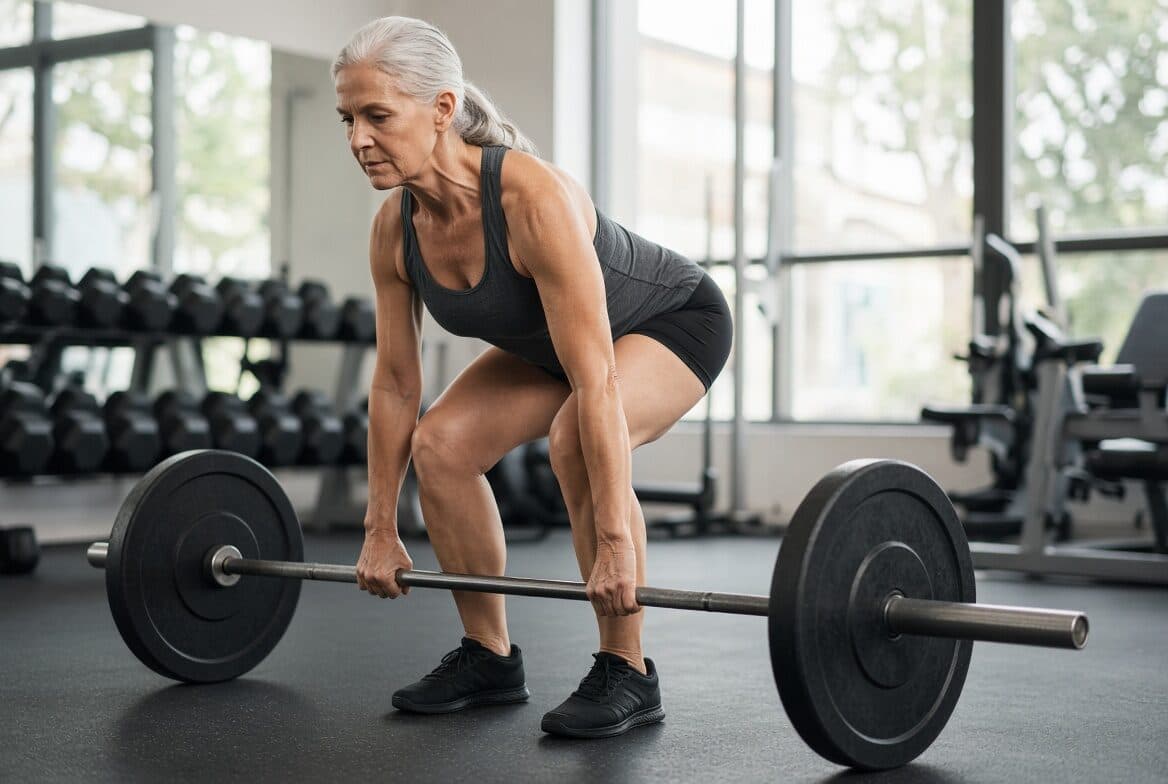
Williams’s program followed the same core principle of progressive overload: systematic increases in load over successive weeks, organized in four-week blocks that included a deload week for recovery. She trained three days per week, performed the main lifts (squat, bench, deadlift) first when energy was highest, and added accessory work for supporting musculature. At 71 she competed at 132 pounds in the squat, 71.5 pounds in the bench press and 242 pounds in the deadlift—records for her age and weight class in Nova Scotia. By 72 her squat had risen further and she was preparing to challenge a higher deadlift mark. These numbers are individual results under coaching; they are not population averages. They do, however, illustrate that meaningful strength gains remain possible decades after the onset of menopause when training is structured and progressive.
Protein, Recovery and Practical Considerations
Resistance training supplies the mechanical signal; protein supplies the substrate. Older muscle exhibits anabolic resistance—it requires a larger per-meal protein dose to achieve the same synthetic response seen in younger adults. Expert groups therefore recommend higher intakes than the standard 0.8 g/kg reference value. For active older adults, targets of 1.0–1.2 g/kg daily are commonly cited, with 1.2–1.6 g/kg (or higher) suggested when the goal is muscle preservation or gain during resistance training. Williams aimed for approximately 120 grams per day from food sources. Distribution across meals matters; boluses of 25–40 grams containing sufficient leucine appear more effective than concentrating the day’s protein in a single sitting. Sleep of 7–8 hours, mobility work, and progressive rather than abrupt increases in load are additional recovery elements that reduce injury risk and support adaptation.
Supervision is particularly important when beginning or returning to heavier loading after a long layoff, or when low bone density is present. The LIFTMOR protocol was delivered under direct supervision; unsupervised heavy lifting in osteoporotic bone carries higher risk. Williams worked with trainers from the outset and continued under coaching. Women with existing joint issues, osteoporosis or other medical conditions should obtain individualized guidance before adopting high-intensity protocols. Starting with lighter loads, mastering technique, and progressing only when form is stable remains the safest path.
Broader Implications for Midlife Women’s Health
The practical message that emerges from both the controlled literature and individual accounts is that chronological age after 50 does not preclude substantial strength gains. The physiological decline associated with menopause and aging is real, but it is not fixed. Two to three sessions per week of progressive resistance training that challenges the major muscle groups, combined with protein intakes above the basic RDA and adequate recovery, reliably improves strength and functional performance. Bone density responds more slowly and appears to require higher-intensity loading under supervision, yet even modest preservation or small gains can be clinically meaningful. For many women the secondary benefits—greater energy, confidence in daily tasks, and reduced fear of falling—matter as much as the numerical improvements on a strength log.
Williams has stated that getting stronger required patience, consistency and a willingness to step outside her comfort zone. The research literature supports the first two of those elements as the primary drivers of adaptation. Programs that begin conservatively, progress systematically, and treat recovery as part of the training itself are the ones most likely to produce durable results into the 70s and beyond. Strength training is not a guarantee against every age-related change, but it remains one of the most effective tools available for preserving the muscle, bone and functional capacity that support independence in later life.
Sources
Williams C, as told to Breitowich A. Women’s Health, 14 November 2026. Supporting evidence drawn from meta-analyses of resistance training in postmenopausal women, the LIFTMOR randomized trial (Watson et al., Journal of Bone and Mineral Research, 2018), and expert recommendations on protein requirements for active older adults.
Research briefings by the gynecology.hospital editorial team summarise published studies and official data, and list their sources at the end of each article.