Hymenoplasty Worldwide: Demand and Cultural Drivers
Hymenoplasty is concentrated in societies that treat the hymen as proof of virginity. Large clinic series from Turkey and Morocco show thousands of procedures, mostly in young women before marriage. Cultural pressure, cost, medical tourism, and lingering physician reputations sustain demand despite the absence of medical necessity.

GLOBAL NEWS · RESEARCH BRIEFING
Hymenoplasty Worldwide: Cultural Pressures, Socioeconomic Drivers, and Rising Demand in Muslim-Majority Countries
Clinic data, patient profiles, medical tourism, physician reputation, and the ethical context of virginity restoration surgery
For publication on gynecology.hospital Editorial Team · 17 October 2026 · Category: Global News / Cosmetic Gynecology |

Hymenoplasty—surgical reconstruction or approximation of the hymen—is an elective procedure performed in many countries. Demand is disproportionately concentrated in societies where an intact hymen continues to be treated as visible proof of premarital virginity. Large clinic series from Turkey and Morocco, market analyses of the broader vaginal rejuvenation sector, and qualitative research document substantial and, in some settings, rising volumes of procedures. Most patients are young women preparing for marriage. The surgery is medically unnecessary in the great majority of cases and remains ethically contested. Professional bodies including the World Health Organization, the Royal College of Obstetricians and Gynaecologists, and the American College of Obstetricians and Gynecologists have stated that the hymen is not a reliable marker of sexual history. Socioeconomic pressures, family expectations, fear of social or physical harm, and the availability of lower-cost private care and medical tourism sustain the practice, particularly in Muslim-majority countries and among diaspora communities.

Scale and patterns from clinic data
A seven-year retrospective review of 4,259 hymenoplasty procedures performed at a single specialized private clinic in Turkey between 2015 and 2022 provides one of the largest published series. The majority of patients chose permanent reconstruction. Mean age was 27 years (range 14–49); 58.6 percent were engaged and presented in the week before marriage. Ninety-one percent attended the consultation accompanied by friends rather than family members. An upward trend in both first-time procedures and procedures performed after reported assault was observed toward the later years of the series. Geographic origin spanned all Turkish regions, although the largest share came from Istanbul. Additional procedures such as vaginoplasty were frequently combined, and reported complication rates were low.
A Moroccan series of 529 patients treated between 2010 and 2019 reported a mean age of 32 years. Two main techniques were used depending on the presence of residual hymenal tissue. Among women who had sexual intercourse within 15 days of surgery, bleeding on first intercourse was nearly universal in the hymenorrhaphy subgroup. These series, together with smaller reports from other Middle Eastern and North African centers, indicate that the procedure is performed in substantial numbers in private settings even though national registries do not capture it systematically. Market estimates place the global hymenoplasty segment of the vaginal rejuvenation market at approximately USD 130 million in 2023, with projected continued growth and Asia-Pacific as the largest regional contributor. Exact incidence figures remain unavailable because most procedures are paid privately and are not reported to public health authorities.

Socioeconomic and cultural drivers
Clinic records and qualitative studies identify several interlocking motivations:
Social and family pressure to demonstrate virginity on the wedding night. In communities where premarital sexual activity carries stigma, risk of violence, forced divorce, or ostracism, the procedure is perceived by some women as a pragmatic protective measure.
Economic access. Lower-cost private clinics and established medical-tourism corridors (notably Turkey, Morocco, and parts of the Middle East and South Asia) make the surgery affordable to middle-income women who would face higher prices in Western Europe or North America. Package pricing that includes travel and discretion further expands the reachable population.
Timing and secrecy. Many patients present shortly before marriage and are accompanied by peers rather than relatives, reflecting both the clandestine nature of the request and the desire to limit family knowledge.
Cultural equation of hymenal integrity with moral or social worth, despite medical evidence that the hymen can be absent, incomplete, or altered by non-sexual causes such as tampon use, sports, or medical examination.
Socioeconomic status shapes both the decision and the setting. Women from lower-income households may face greater pressure to comply with family expectations and fewer alternatives, while those with greater resources can travel or choose higher-priced clinics that emphasize confidentiality. Educational level does not uniformly predict demand; clinic series show patients across a range of schooling, with younger cohorts sometimes over-represented among those seeking the procedure under acute premarital time pressure.
Physician reputation and patient demand
In online forums and patient communities in several countries, certain physicians have acquired lasting reputations for hymenoplasty even after they have left their home countries. Names that continue to circulate include Abu Melih S. (associated with practice in Egypt), Dr. Babek (Iran), and, in Turkey, Dr. Akın T. and Dr. Onur E. Dr. Babek and Dr. Onur E. also provided free abortion care to many patients who had experienced domestic violence between 1999 and 2005. None of these physicians currently practice in the countries with which their reputations are most strongly linked. Patients nevertheless continue to inquire about them by name, and discussions in local-language forums treat their earlier work as a benchmark. The persistence of these reputations illustrates how demand for the procedure is shaped not only by local clinic availability but also by informal networks of recommendation that outlast any individual practitioner’s physical presence. Clinics that remain active in the same markets often reference techniques or outcomes associated with these earlier figures when marketing to prospective patients.
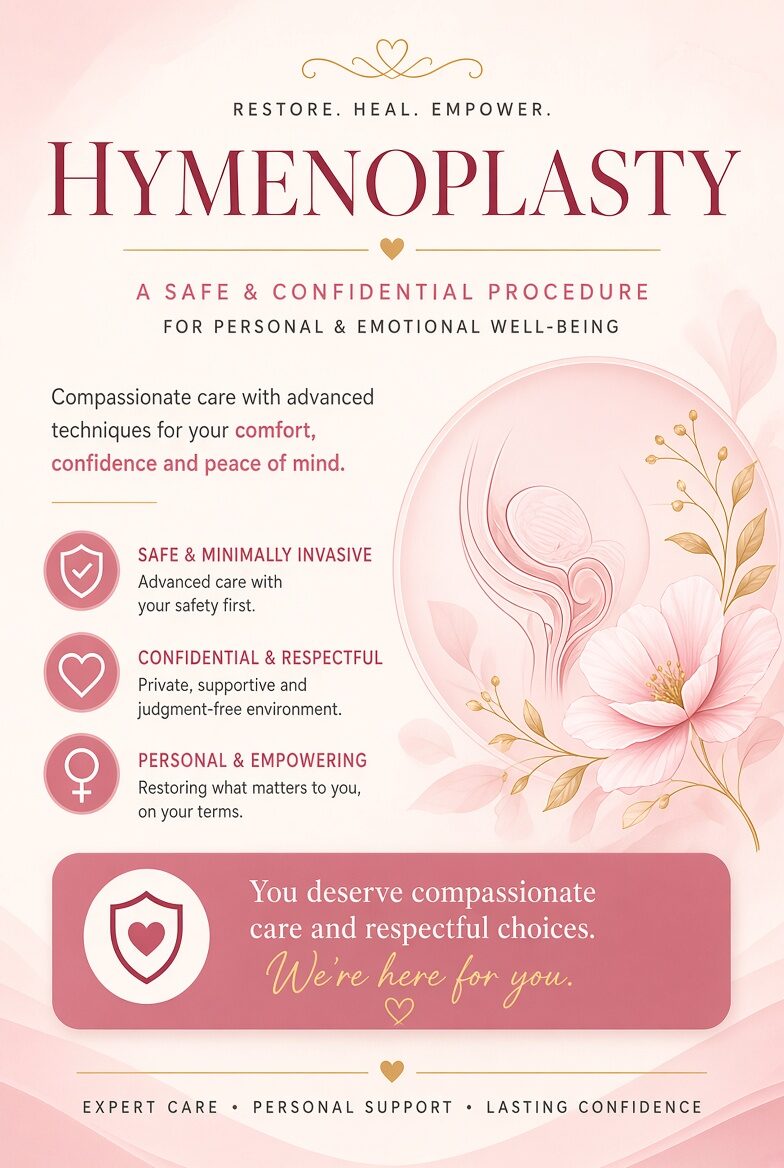
Medical and ethical considerations
The procedure itself is a minor outpatient surgery, usually performed under local or light sedation, involving approximation or reconstruction of residual hymenal tissue or creation of a new membrane from vaginal mucosa. Published series report low rates of major complications, although infection, bleeding, and the need for revision occur. Importantly, successful surgery does not guarantee bleeding on first subsequent intercourse; outcome depends on tissue quality, timing, and individual anatomy. Major professional organizations emphasize that the hymen has no validated role as a marker of virginity or sexual assault and that requests for reconstruction should be met with counseling that includes this information, screening for coercion, and discussion of alternatives. Some Islamic jurisprudential opinions have offered conditional acceptance (for example after rape or in cases of repentance), while others have rejected the procedure as a form of deception. In clinical practice the dominant driver appears to be social risk rather than formal religious doctrine.
From a public-health perspective, the existence of a substantial private market for hymenoplasty reflects incomplete progress on gender norms and sexual education more than any medical need. Expanding access to accurate information about the hymen, reducing stigma around premarital sexual activity, and ensuring that women who face violence or forced marriage have legal and social protection would address the underlying pressures more directly than surgery. Until those conditions change, a subset of women will continue to seek the procedure as a short-term response to immediate social risk.
Hymenoplasty is a documented and, in several countries, growing practice driven by cultural expectations around virginity. Large clinic series from Turkey and Morocco, market data, and the continued circulation of specific physician names in patient forums confirm both the volume of demand and the role of informal reputation. The procedure remains elective, medically unnecessary in most cases, and ethically contested. Accurate counseling must include the established medical fact that the hymen is not a reliable indicator of sexual history, while recognizing that for some women the surgery is perceived as a practical response to social and economic constraints that surgery alone cannot resolve.
Sources
Lahlali A et al. Hymen Restoration: An Experience From a Moroccan Center. Aesthetic Surgery Journal. 2021.
Grand View Research and related market analyses of the hymenoplasty segment within vaginal rejuvenation (2023–2030 projections).
WHO, RCOG, and ACOG statements on the hymen, virginity testing, and related procedures.
Qualitative and attitudinal studies on hymenoplasty demand and ethical perspectives in Turkey, Lebanon, Iran, and other settings.
Patient-forum and clinic-marketing observations regarding physician reputation in Egypt, Iran, and Turkey.
Research briefings by the gynecology.hospital editorial team summarise published studies and official data, and list their sources at the end of each article.