Abortion Gestational Limits and Restrictive Law Enforcement
Abortion laws set widely varying gestational limits, with 12 weeks the most common threshold for on-request care. Poland’s post-2020 near-ban has been linked to deaths and physician convictions for delayed care. Restrictive laws elsewhere create legal risk for providers and shift procedures outside formal systems.
GLOBAL NEWS · RESEARCH BRIEFING
Abortion Gestational Limits Worldwide and the Enforcement of Restrictive Laws
Legal thresholds by country, the Polish near-ban and related prosecutions, and patterns of enforcement against providers in restrictive settings
For publication on gynecology.hospital Editorial Team · 17 October 2026 · Category: Global News / Abortion Law |
Abortion laws vary widely by gestational age limit and by the grounds on which the procedure is permitted. The most common limit for abortion on request is 12 weeks from the last menstrual period. A smaller number of countries allow later access on request or on broad socioeconomic grounds, while others restrict abortion to cases of life endangerment, rape, or severe fetal anomaly, or ban it almost entirely. Restrictive regimes do not eliminate abortion; they shift it outside formal care and create legal risk for both women and providers. Documented prosecutions of physicians are relatively uncommon compared with the volume of procedures, but high-profile cases—particularly in Poland—illustrate the chilling effect that criminal penalties can produce.
Gestational limits and legal frameworks
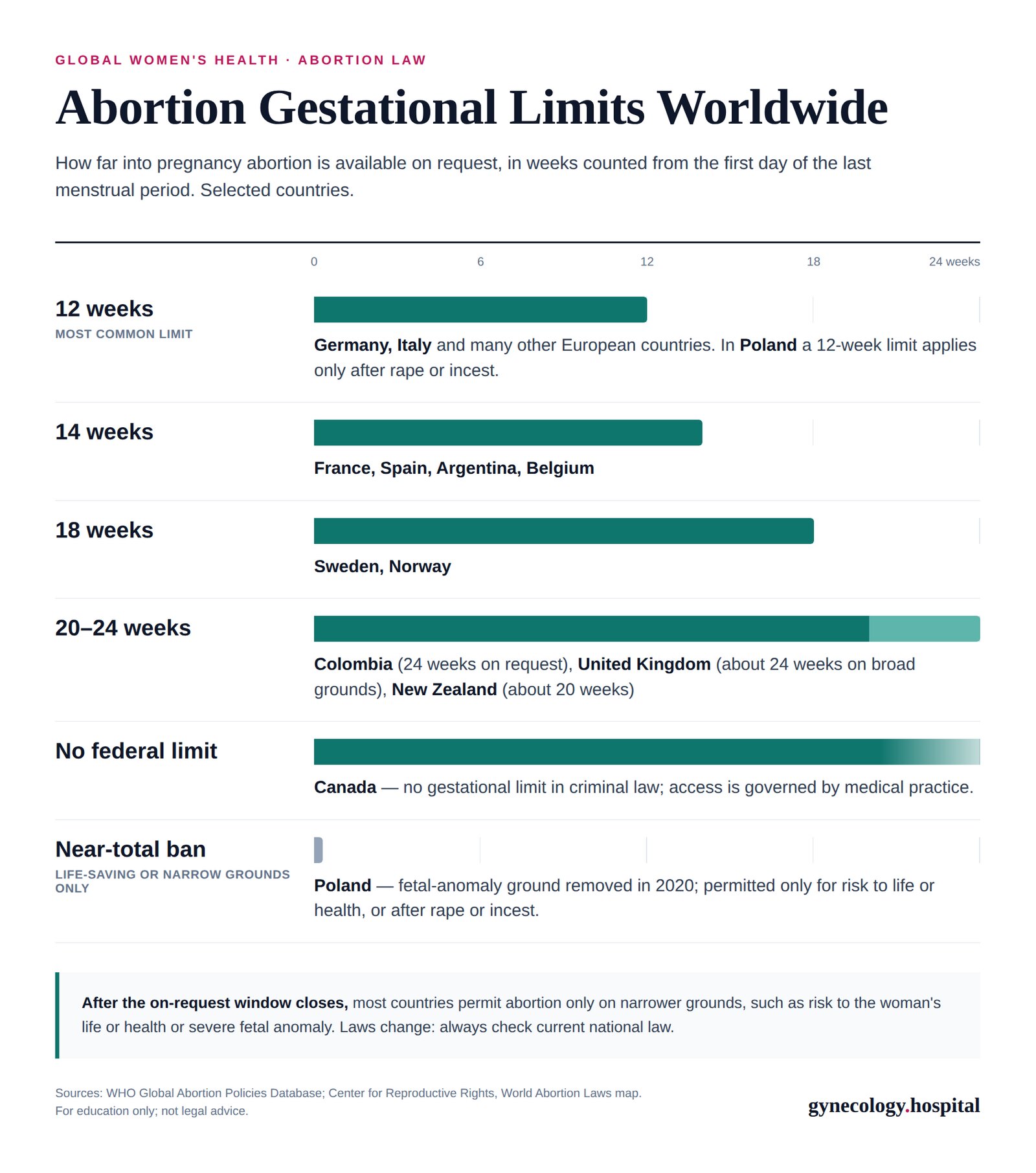
According to the Center for Reproductive Rights World Abortion Laws map and the WHO Global Abortion Policies Database, roughly 34 percent of women of reproductive age live in countries that permit abortion on request. The most frequent gestational threshold in this group is 12 weeks. Examples include many European countries (Germany and Italy at 12 weeks, France at 14 weeks after a 2022 extension, Sweden at 18 weeks). Some jurisdictions set later limits or none: Colombia permits abortion on request up to 24 weeks; several U.S. states and a few other countries allow care until viability or have no statutory cutoff. After the on-request window, most systems require narrower grounds such as risk to life or health, fetal anomaly, or rape.
Gestational limits for abortion on request: selected countries
Gestational limit | Countries (abortion on request) |
|---|---|
12 weeks (most common) | Germany, Italy and many other European countries. In Poland a 12-week limit applies only in cases of rape or incest. |
14 weeks | France, Argentina, Spain, Belgium |
18 weeks | Sweden, Norway |
20–24 weeks | Colombia (24 weeks on request), United Kingdom (about 24 weeks on broad grounds), New Zealand (about 20 weeks) |
Near-total ban / life-saving only | Poland (fetal anomaly ground removed after 2020; permitted only for risk to life or health, or rape/incest) |
No federal limit | Canada |
After the on-request window closes, most countries permit abortion only on narrower grounds such as risk to life or health or fetal anomaly. Limits are usually counted from the first day of the last menstrual period.
At the restrictive end, approximately 21 countries prohibit abortion altogether, and a larger group permits it only to save the pregnant person’s life. Poland falls into the near-ban category. Following a 2020 Constitutional Tribunal ruling that removed fetal anomaly as a legal ground, abortion is permitted only in cases of rape, incest, or danger to the woman’s life or health. In practice, the number of legal procedures fell sharply after the ruling. Similar narrow frameworks exist in parts of Latin America, Africa, and Asia, where the combination of legal limits and limited service availability drives women toward clandestine care.

Poland: the near-ban and documented cases
Poland’s post-2020 framework has produced several high-profile cases involving physicians. In 2021, 30-year-old Izabela died of sepsis at 22 weeks of pregnancy after her waters broke and doctors delayed intervention. In July 2025 a Polish court convicted three doctors in connection with her death. Two received prison sentences (15 and 18 months) and professional bans of six years; the third received a one-year suspended sentence and a four-year ban. The charges centered on exposing the patient to danger of loss of life; prosecutors had earlier concluded that the abortion law itself did not dictate the clinical decisions, yet the case became emblematic of the chilling effect described by rights groups. A separate investigation into a doctor who performed an abortion in the ninth month of pregnancy in 2024 was later dropped after prosecutors found no violation of the existing law. These episodes illustrate both the narrow remaining grounds and the legal uncertainty faced by clinicians.
Enforcement patterns in other restrictive settings
Prosecutions of physicians for performing abortions outside legal grounds occur in several countries with narrow laws, but published, verified cases remain relatively few relative to estimated procedure volumes. In settings where abortion is criminalized except to save life, doctors may face charges for exceeding that threshold or for failing to document the indication adequately. Women themselves are more frequently the target of investigation in some jurisdictions. The practical effect of criminal penalties is often greater than the number of convictions: clinicians report hesitation to act in borderline cases for fear of prosecution, which can delay care even when a legal ground exists. Medical tourism and self-managed medication abortion have become common responses in countries with early gestational cutoffs or near-total bans.
Gestational limits and legal grounds for abortion differ substantially across countries. Twelve weeks remains the most common threshold for abortion on request; later access or near-total bans exist in other systems. Poland’s post-2020 near-ban has been associated with documented deaths and subsequent convictions of physicians for failures of care, underscoring the chilling effect of restrictive criminal law. In other highly restrictive countries, prosecutions of providers occur but are less systematically reported. The combination of narrow legal grounds, gestational cutoffs, and enforcement risk continues to shape both access and clinical decision-making.
Sources
Center for Reproductive Rights. World Abortion Laws map (updated continuously).
WHO Global Abortion Policies Database.
Polish court reporting and news accounts of the 2021 Izabela case and 2025 convictions (BBC, AP, Notes from Poland, Politico).
Comparative analyses of gestational limits and legal grounds from Guttmacher Institute and related sources.
Research briefings by the gynecology.hospital editorial team summarise published studies and official data, and list their sources at the end of each article.