Postpartum Depression: Global Prevalence, Screening and Care
Postpartum depression is one of the most common yet under-recognised complications of childbirth. Diagnostic-interview estimates place postpartum major depression at about 6.8%, with the highest rates in southern sub-Saharan Africa and South Asia. Only about 10% of cases are identified in low- and middle-income countries; WHO-endorsed task-sharing models such as the Thinking Healthy Programme offer scalable treatment.

Postpartum Depression and Maternal Mental Health: Global Prevalence, Screening and Treatment Access
Editorial analysis • November 2026
Abstract
Postpartum depression remains one of the most common yet under-recognised complications of childbirth worldwide. Large meta-analyses using symptom scales report pooled prevalences of 17–19 %, while recent diagnostic-interview-based estimates place the point prevalence of major depressive disorder at approximately 6.8 % during the postpartum year after adjustment for measurement bias. Rates are substantially higher in southern sub-Saharan Africa and South Asia. The Edinburgh Postnatal Depression Scale is the dominant screening instrument, yet only about 10 % of cases are identified in low- and middle-income countries. Treatment access is constrained by workforce shortages, stigma and weak referral systems. Evidence supports task-sharing models such as the WHO Thinking Healthy Programme. Untreated illness is associated with impaired mother–infant bonding and measurable adverse effects on child cognitive and socio-emotional development. This article synthesises current global evidence on prevalence, screening performance, access barriers and scalable responses.

1. Distinguishing screening symptoms from clinical diagnosis
The term “postpartum depression” is used in two distinct ways in the literature. Symptom-scale studies, most commonly employing the Edinburgh Postnatal Depression Scale (EPDS) or the Patient Health Questionnaire, capture elevated depressive symptoms. These yield higher prevalence figures. In contrast, studies that apply structured diagnostic interviews identify major depressive disorder (MDD) according to DSM or ICD criteria and produce lower estimates.
A 2026 Lancet Psychiatry systematic review and meta-regression of 1,505 prevalence datapoints from 780 studies (over 2 million women across 90 countries) quantified the overestimation. Symptom scales inflated MDD prevalence by 71 % for the EPDS in the postpartum period and by 122 % for the PHQ during pregnancy relative to diagnostic interviews. After correction for this bias and for timing within the perinatal period, the adjusted point prevalence of MDD was 6.2 % (95 % UI 5.9–6.6) at any time during pregnancy and 6.8 % (6.4–7.1) during the postpartum year. Prevalence peaked in the first two weeks after birth and remained elevated throughout the first year compared with pregnancy.
Earlier large EPDS-based meta-analyses reported higher figures. A 2021 analysis of 565 studies from 80 countries found a pooled prevalence of 17.22 %. An updated 2023 Frontiers in Psychiatry meta-analysis of 412 studies (792,055 women, 46 countries) estimated 19.18 % (95 % CI 18.02–20.34). These numbers remain useful for describing the burden of clinically significant symptoms, but they should not be equated with diagnosed major depression.

2. Global prevalence patterns and regional disparities
Geographic variation is large. In the 2026 diagnostic-interview-adjusted analysis, southern sub-Saharan Africa showed the highest rates (15.6 % during pregnancy to 16.6 % in the postpartum year), followed by South Asia (13.7–14.6 %). High-income Asia Pacific recorded the lowest figures (3.1–3.3 %). Earlier EPDS-based work identified Southern Africa at nearly 40 % and Afghanistan above 60 % in some samples, while Singapore and the Netherlands reported rates below 10 %.
A 2023 JAMA Psychiatry meta-analysis focused on low- and middle-income countries (589 studies, 616,708 women) found an overall perinatal depression prevalence of 24.7 % on screening instruments, with only modest differences by income stratum. COVID-19-era umbrella reviews reported antenatal and postpartum depression prevalences around 29 % and 26 % respectively during the pandemic, higher than pre-pandemic baselines.
These gradients track known risk factors: poverty, intimate-partner violence, limited social support, high fertility rates, and restricted access to maternity care. Nutritional patterns have also been examined; one meta-regression linked higher national consumption of sugar-sweetened beverages with elevated EPDS-based prevalence, although the ecological design limits causal inference.

3. Screening tools: the role and limits of the EPDS
The 10-item Edinburgh Postnatal Depression Scale remains the most widely validated and used instrument globally. A 2020 BMJ individual-participant-data meta-analysis of 58 studies (15,557 women) showed that a cut-off of 11 or higher maximised combined sensitivity and specificity (approximately 0.81 and 0.88 against semi-structured interviews). Cut-offs of 10 and 13 are commonly applied in practice; the higher threshold improves specificity at the cost of sensitivity.
The scale has been translated into dozens of languages and demonstrates acceptable psychometric properties across diverse settings, though cultural adaptation of items is still required in some contexts. It is a screening, not a diagnostic, tool. Positive screens require clinical assessment. Item 10, which enquires about self-harm thoughts, demands immediate clinical attention whenever endorsed.
WHO guidance recommends routine enquiry about mental health within postnatal care. In practice, systematic screening is far from universal. In low- and middle-income countries only about 10 % of women with perinatal depression are identified. Barriers include absence of validated tools in local languages, lack of staff training, time pressure in antenatal and postnatal clinics, and the absence of clear referral pathways once a woman screens positive.
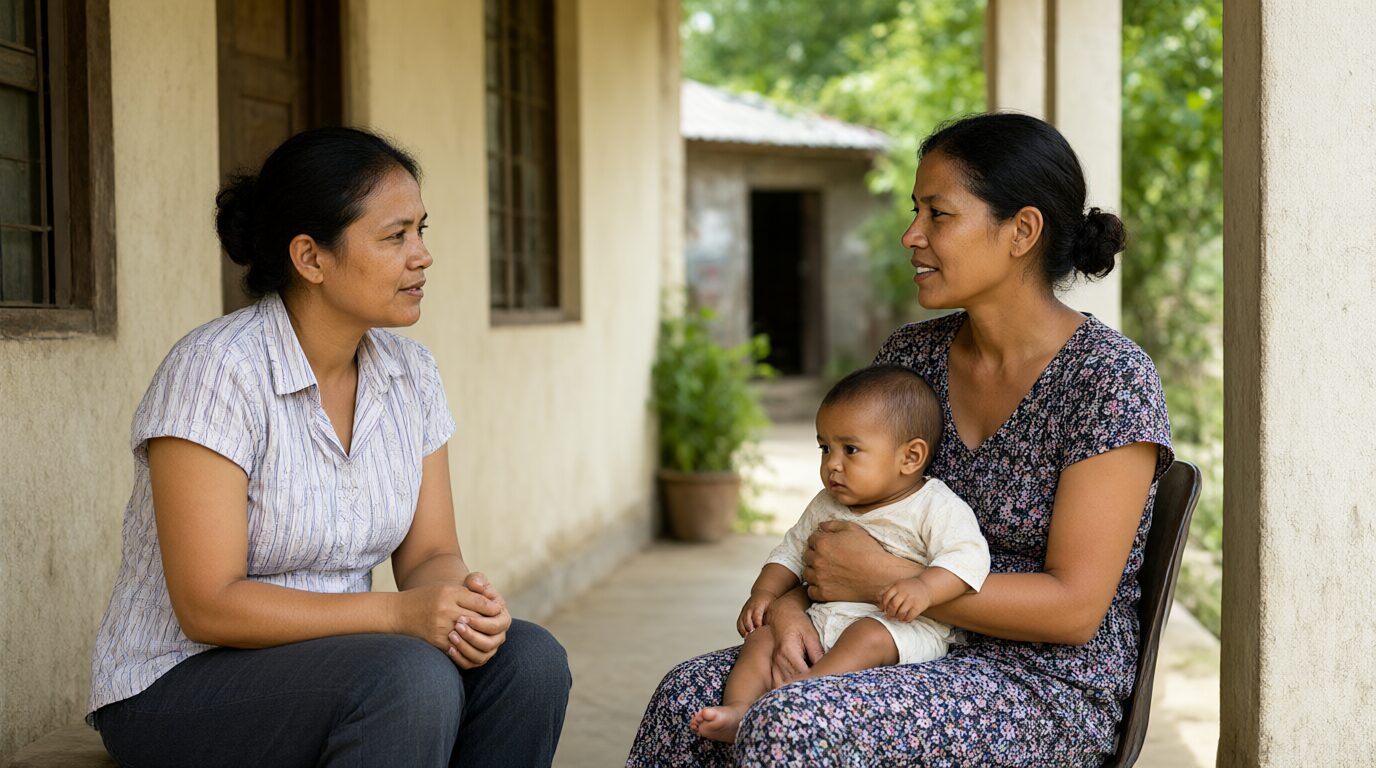
4. The treatment gap in low- and middle-income countries
Even when depression is recognised, treatment access is severely constrained. Low-income countries typically have fewer than one mental-health professional per 100,000 population. Primary-care clinicians are overburdened and often lack confidence in managing perinatal mental disorders. Stigma remains powerful; in many communities symptoms are interpreted as spiritual problems, personal weakness or the result of poor family relationships rather than a treatable medical condition.
Pharmacological options are limited by concerns about breastfeeding safety and by irregular drug supply. Psychosocial interventions therefore form the first-line approach recommended by WHO. The Thinking Healthy Programme, originally developed and trialled in Pakistan, is a structured cognitive-behavioural intervention delivered by community health workers. Randomised evidence showed it roughly halved the prevalence of perinatal depression and improved infant outcomes. WHO has published a field-tested manual for its integration into maternal and child health services. Peer-delivered adaptations have been evaluated in India and Pakistan and show acceptable feasibility and modest clinical effects.
Task-sharing models, supported by the WHO Mental Health Gap Action Programme (mhGAP), allow non-specialists to deliver brief, structured psychological treatments under supervision. Digital tools for training and supervision are being tested to overcome geographic barriers. Despite these advances, large-scale implementation remains the exception. Financial constraints, high caseloads and weak health-system integration continue to leave the majority of women untreated.

5. Consequences for mother–infant bonding and child development
Untreated postpartum depression impairs maternal functioning and disrupts sensitive caregiving. Multiple studies document higher rates of bonding difficulties; one recent cohort found that 69 % of mothers with postpartum depression reported poor mother–infant bonding. Bonding problems mediate a substantial fraction of the association between maternal depressive symptoms and later child difficulties.
Meta-analyses link perinatal depression and anxiety to poorer offspring social-emotional, cognitive, language and adaptive development. Effects are detectable in infancy and persist into childhood and adolescence. Persistent and severe postnatal depression has been associated with elevated risk of behavioural problems at age 3.5 years, lower mathematics attainment at 16 and higher rates of depression in late adolescence. Male children appear particularly sensitive to reductions in maternal responsiveness in some IQ studies. In low- and middle-income settings, perinatal depression is also associated with increased odds of childhood stunting and underweight.
For the mother herself, postpartum depression raises the risk of chronic depression and suicidality. One community cohort reported a 16-fold higher odds of elevated suicidality among women with postpartum depression. These outcomes underline the intergenerational nature of the condition and the public-health case for early detection and treatment.

6. Scalable pathways: integration and task-sharing
The most promising route to closing the gap is the systematic integration of mental-health components into existing maternal and child health platforms. WHO’s 2022 guide on perinatal mental health outlines practical steps for policy-makers and programme managers: situation analysis, adaptation of screening and treatment protocols, training of non-specialists, establishment of supervision and referral systems, and monitoring.
Low-intensity psychosocial interventions delivered universally or to women with elevated symptoms have evidence of effectiveness for both prevention and treatment. Peer support, group formats and digital delivery further expand reach. Where specialist services exist, stepped-care models that reserve psychiatrists and psychologists for complex cases improve efficiency. Antidepressants remain an option when psychosocial measures are insufficient, provided breastfeeding safety and local availability are considered.
Implementation research continues to identify practical obstacles—supervision quality, staff turnover, community stigma and financing. Successful programmes have invested in formative work to adapt content culturally, have engaged community leaders, and have embedded mental-health indicators into routine maternal health information systems.
Conclusion
Postpartum depression affects a substantial minority of women in every region, with the highest diagnostic rates concentrated in parts of Africa and Asia. Screening tools such as the EPDS can identify women at risk, yet identification and treatment remain rare in most low- and middle-income settings. The condition is not merely a maternal health issue; it shapes early mother–infant interaction and carries measurable risks for child development. Evidence-based, low-intensity interventions delivered through task-sharing are available and endorsed by WHO. Their widespread adoption within routine maternity care represents the most realistic path to reducing both the human and the intergenerational burden of perinatal depression.
References
1. The global prevalence of major depressive disorder during the peripartum period: a systematic review and meta-regression. Lancet Psychiatry. 2026;13(6):461–471.
2. Nutritional factors and cross-national postpartum depression prevalence: an updated meta-analysis and meta-regression of 412 studies from 46 countries. Front Psychiatry. 2023;14:1193490.
3. Mapping global prevalence of depression among postpartum women. Transl Psychiatry. 2021;11:543.
4. Prevalence of Perinatal Depression in Low- and Middle-Income Countries: A Systematic Review and Meta-analysis. JAMA Psychiatry. 2023;80(5):425–431.
5. Accuracy of the Edinburgh Postnatal Depression Scale (EPDS) for screening to detect major depression among pregnant and postpartum women: systematic review and meta-analysis of individual participant data. BMJ. 2020;371:m4022.
6. World Health Organization. Thinking Healthy: A manual for psychosocial management of perinatal depression. WHO, 2015.
7. World Health Organization. Guide for integration of perinatal mental health in maternal and child health services. WHO, 2022.
8. Association Between Maternal Perinatal Depression and Anxiety and Child and Adolescent Development: A Meta-analysis. JAMA Pediatr. 2020;174(11):1082–1092.
9. Identification, treatment and prevention of perinatal depression in Low- and Middle-Income Countries – a narrative review. Biol Psychiatry. 2026.
Prepared for gynecology.hospital. Content is original and based on published peer-reviewed sources. Not a substitute for individual clinical advice.
Research briefings by the gynecology.hospital editorial team summarise published studies and official data, and list their sources at the end of each article.