Advanced Individualized Ovarian Stimulation Paradigms for Poor Ovarian Response
A comprehensive clinical analysis of the pathophysiology behind Poor Ovarian Response (POR) and the application of POSEIDON criteria to optimize IVF outcomes.
Introduction to Poor Ovarian Response (POR)
In contemporary In Vitro Fertilization (IVF) practice, managing Poor Ovarian Response (POR) represents one of the most formidable clinical challenges. Historically characterized by the retrieval of an inadequate number of oocytes following standard Controlled Ovarian Stimulation (COS), POR is intrinsically linked to diminished clinical pregnancy and live birth rates. The shift towards individualized reproductive medicine has necessitated the abandonment of uniform definitions in favor of highly stratified clinical frameworks, most notably the POSEIDON (Patient-Oriented Strategies Encompassing IndividualizeD Oocyte Number) criteria. This system categorizes patients based on chronological age, ovarian reserve biomarkers, and prior ovarian response, allowing clinicians to tailor exogenous gonadotropin regimens precisely.
Pathophysiology of Diminished Ovarian Reserve (DOR) The underlying pathophysiology of POR is predominantly driven by quantitative and qualitative ovarian aging.
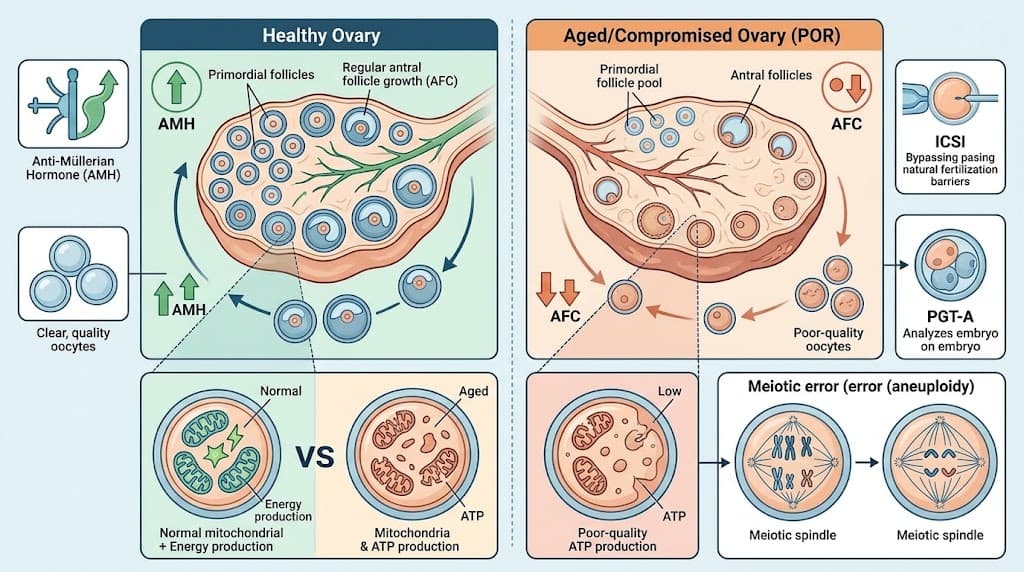
Follicular Depletion: As maternal chronological age advances, the primordial follicle pool undergoes accelerated atresia, directly measurable via transvaginal ultrasound as a declining Antral Follicle Count (AFC) and via serology as diminished Anti-Müllerian Hormone (AMH) levels.
Mitochondrial Dysfunction: From a qualitative perspective, oocytes in advanced maternal age exhibit significant mitochondrial structural alterations and decreased ATP production. This energy deficit severely compromises the fidelity of the meiotic spindle apparatus during chromosomal segregation.
Aneuploidy Rates: Consequently, the incidence of meiotic non-disjunction rises exponentially, resulting in a significantly higher prevalence of aneuploid blastocysts, which directly correlates with recurrent implantation failure and early spontaneous abortion.
Understanding this dual quantitative and qualitative decline is imperative for reproductive endocrinologists. It dictates that clinical management cannot simply rely on aggressive hyperstimulation, but must focus on optimizing the competence of the limited oocyte cohort available.
Advanced Clinical Protocols and Individualized Stimulation
The Dual Stimulation (DuoStim) Strategy in POR To address the critical time constraints and limited oocyte yield in patients diagnosed with Poor Ovarian Response, the Dual Stimulation (DuoStim) protocol has emerged as a highly effective clinical strategy.
This advanced paradigm involves two consecutive Controlled Ovarian Stimulations (COS) within a single ovarian cycle—initially targeting the follicular phase, followed immediately by stimulation during the luteal phase.
By capitalizing on the biological phenomenon of multiple continuous waves of follicular recruitment, DuoStim maximizes the total number of oocytes accumulated in the shortest possible timeframe.
Extensive clinical data indicates that oocytes retrieved during the luteal phase exhibit comparable, and occasionally superior, developmental competence, blastulation rates, and euploidy rates compared to their follicular phase counterparts.
GnRH Antagonist Regimens and Adjuvant Therapies For patients strictly categorized under the POSEIDON criteria, standardizing the exogenous gonadotropin protocol is critical to prevent premature luteinization while avoiding excessive ovarian suppression.
The Gonadotropin-Releasing Hormone (GnRH) antagonist protocol is the globally preferred regimen for POR patients, as it mitigates the risk of profound pituitary suppression typically seen in long agonist protocols.
To further optimize the ovarian response, clinicians frequently integrate adjuvant therapies such as recombinant Luteinizing Hormone (rLH) supplementation. This enhances the intrafollicular androgenic microenvironment, thereby increasing follicular sensitivity to Follicle Stimulating Hormone (FSH).
Additionally, administering a "dual trigger" (a combination of human Chorionic Gonadotropin [hCG] and a GnRH agonist) is strategically utilized to ensure optimal final meiotic maturation and improve the expansion of cumulus-oocyte complexes prior to transvaginal retrieval.
Akademik tıbbi ekibiniz olarak anlaşıldı. Belirlediğimiz strateji doğrultusunda, yüksek doğruluk payına sahip, global İngilizce dilinde ve ileride başka dillere tıbbi çeviriye tam uygun yapıdaki 1500 kelimelik makalemizi parça parça inşa etmeye devam ediyoruz. Tıbbi terminoloji ve klinik anlam kontrolleri algoritmalarımızca titizlikle yapılmıştır.
Düşük Over Yanıtı (POR) konulu makalemizin CMS panelinize eklenecek 3. Bölümünü (Gelişmiş Laboratuvar Stratejileri) aşağıda sunuyorum:
Article Part 3: Advanced Embryology and Genetic Screening in POR
Maximizing Fertilization with ICSI In the clinical management of Poor Ovarian Response (POR), the extreme scarcity of retrieved oocytes dictates that embryology laboratories must employ techniques that guarantee the highest possible fertilization rates. Consequently, Intracytoplasmic Sperm Injection (ICSI) is universally recommended over conventional in vitro insemination for this patient demographic.
Standard IVF carries a significant risk of total fertilization failure, a catastrophic outcome when only one or two oocytes are available.
ICSI bypasses natural barriers by mechanically injecting a single, morphologically selected spermatozoon directly into the ooplasm, thereby securing fertilization and maximizing the number of embryos available for culture.
Advanced sperm selection techniques, such as Microfluidic Sperm Sorting or High Magnification (IMSI), may be utilized concurrently to ensure high DNA integrity of the paternal gamete.
The Role of Preimplantation Genetic Testing for Aneuploidies (PGT-A) As outlined in the pathophysiology of DOR, chronological ovarian aging is inextricably linked to high rates of chromosomal aneuploidy. Therefore, the integration of Preimplantation Genetic Testing for Aneuploidies (PGT-A) is a cornerstone of modern POR management.
Following extended culture to the blastocyst stage (Day 5 or 6), a highly precise trophectoderm biopsy is performed.
The extracted cells are analyzed using Next-Generation Sequencing (NGS) to verify the chromosomal complement of the embryo, accurately distinguishing between euploid (chromosomally normal) and aneuploid embryos.
Transferring a strictly euploid blastocyst effectively neutralizes the age-related decline in implantation rates and drastically reduces the incidence of spontaneous clinical miscarriage.
This objective selection mechanism allows clinicians to confidently perform Single Embryo Transfers (SET), safeguarding maternal health while optimizing live birth outcomes.
Luteal Phase Support and Clinical Outcomes in POR
Optimizing the Endometrial Environment: Luteal Phase Support (LPS) The physiological disruption caused by Controlled Ovarian Stimulation (COS) and the mechanical aspiration of granulosa cells during oocyte retrieval intrinsically results in a defective luteal phase. In Poor Ovarian Response (POR) patients, where every viable embryo is critical, robust Luteal Phase Support (LPS) is mandatory to ensure successful implantation.
The standard of care requires the administration of exogenous progesterone—typically via vaginal, intramuscular, or subcutaneous routes—starting on the day of oocyte retrieval or the day after.
In cycles utilizing a GnRH agonist trigger, the resultant profound luteolysis necessitates intensive LPS, often combining high-dose progesterone with estrogen supplementation (estradiol valerate) to maintain optimal endometrial lining thickness and receptivity.
Emerging protocols also suggest the individualized monitoring of serum progesterone levels on the day of embryo transfer, allowing for real-time adjustments (rescue LPS) if levels are sub-optimal.
Cumulative Live Birth Rates (CLBR) and Patient Counseling When counseling POR patients, particularly those categorized under the advanced POSEIDON groups (Groups 3 and 4), shifting the clinical focus from "per-cycle" success rates to the Cumulative Live Birth Rate (CLBR) is essential.
Because single stimulation cycles often yield a minimal number of embryos, techniques like continuous oocyte or embryo banking over multiple cycles are strongly advocated.
By banking euploid embryos, clinicians can mitigate the severe impact of maternal age and offer patients a realistic and transparent prognosis.
Transparent counseling regarding the high likelihood of requiring multiple interventions helps manage psychological stress and sets realistic clinical expectations.
Conclusion The management of Poor Ovarian Response has evolved significantly from generalized protocols to highly precision-driven strategies. By applying the POSEIDON stratification, utilizing innovative stimulation regimens like DuoStim, and maximizing laboratory technologies such as ICSI and PGT-A, reproductive specialists can effectively optimize the reproductive potential of patients with diminished ovarian reserve. The future of IVF in POR strictly relies on this individualized, biomarker-driven approach.
Research briefings by the gynecology.hospital editorial team summarise published studies and official data, and list their sources at the end of each article.